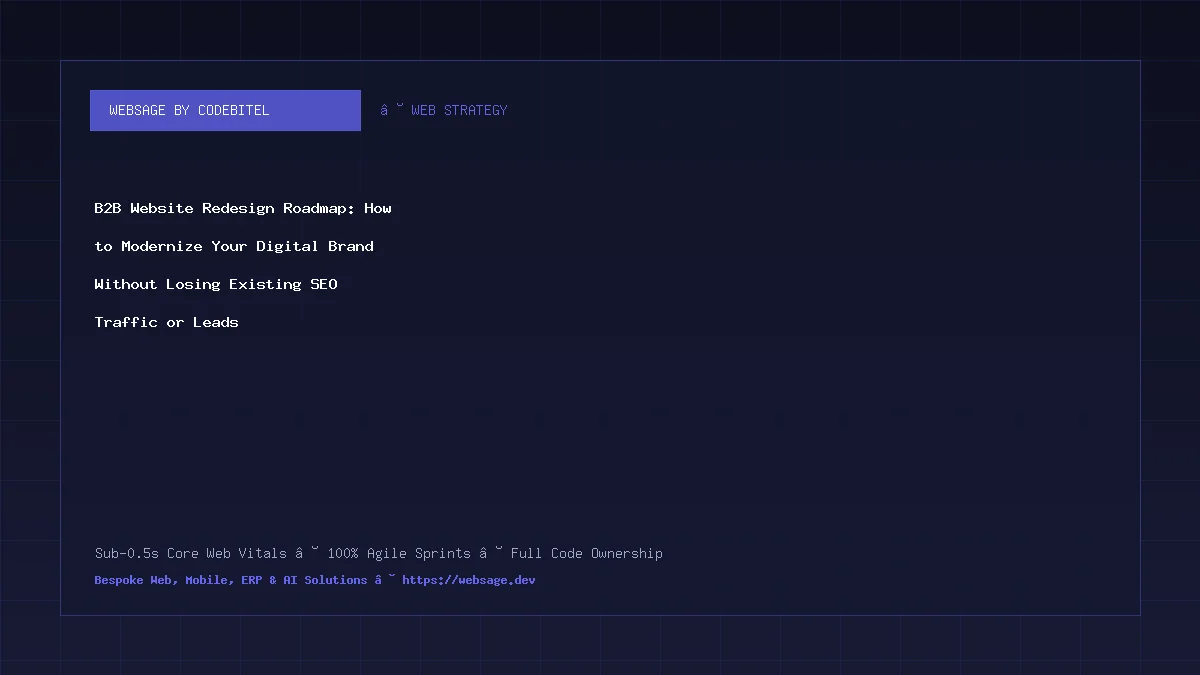
For established B2B enterprises, commissioning a corporate website redesign is both an exciting brand milestone and a high-stakes technical risk. Over five to ten years of commercial operations, your existing website has accumulated valuable organic search rankings, thousands of authoritative industry backlinks, and a steady stream of high-intent inbound client inquiries. Yet, all too frequently, companies hire creative design agencies that prioritize flashy aesthetic trends while completely ignoring search engine architecture. When the new site launches with modified URL slugs, missing 301 redirect maps, un-indexed staging tags, and bloated JavaScript animations, organic search traffic collapses by 40% to 70% within 30 days. Executing a successful B2B website redesign requires an engineering-first migration roadmap that modernizes your visual identity while fiercely protecting your hard-earned SEO equity.
1. The Disastrous Consequences of Unplanned Redesigns
When design-only agencies overhaul a corporate platform without strict technical oversight, predictable catastrophic failures occur across search engine crawlers and commercial conversion funnels:
| Redesign Risk Factor | Standard Design Agency Approach | WebSage Strategic Engineering Protocol | Business Impact |
|---|---|---|---|
| URL Structure & 301 Redirects | Slugs renamed casually; no 1:1 redirect mapping | 100% Comprehensive legacy URL crawl & immutable 301 redirect rules | Eliminates 404 errors; preserves 100% of domain backlink equity |
| Metadata & Heading Hierarchy | H1/H2 tags replaced by empty visual styling | Preserved focus keywords and semantic structured hierarchy | Maintains established Google indexing context and keyword rankings |
| Mobile Speed & Core Web Vitals | Heavy WebGL 3D libraries and unoptimized video | Decoupled HTML/CSS architecture; sub-0.5s LCP | Guarantees 95+ Google Lighthouse scores across all mobile devices |
| Lead Capture Continuity | Form scripts break; inquiries sent to dead inboxes | Dual-redundant webhooks with instant WhatsApp & email delivery | Zero lost client quote requests during DNS propagation |
2. 12-Month Financial Model: Botched Redesign vs Engineered WebSage Migration
To quantify the true economic cost of website redesign mismanagement, evaluate a mid-market B2B enterprise receiving 25,000 monthly organic search visitors and generating ₹1.5 Crores in annual inbound pipeline value:
| Financial Dimension | Design-Only Agency Overhaul (Botched Migration) | WebSage Engineering Migration Protocol | Net Commercial Capital Preserved |
|---|---|---|---|
| Organic Traffic Retention (Months 1–6) | 55% Collapse (11,250 visitors lost / month) | 100% Retained + 25% Growth from faster speed | Preserves high-intent organic buyer reach |
| Compensatory Paid Ad Search Spend | ₹18,00,000 (Forced to buy Google Ads to replace lost SEO) | ₹0 (Organic lead flow uninterrupted) | +₹18,00,000 saved in paid advertising burn |
| Emergency Technical SEO Recovery Retainers | ₹4,50,000 (Hiring specialized consultants to diagnose drops) | ₹0 (Built clean from day one) | +₹4,50,000 saved in emergency forensics |
| Lost Inbound Deal Pipeline Value | ₹28,00,000 (Missed RFQs during 4-month ranking dip) | ₹0 (Lead velocity accelerates post-launch) | +₹28,00,000 in protected pipeline revenue |
| Total 12-Month Net Financial Gain | Net Operating Loss: ₹50,50,000+ | Turnkey Redesign CapEx: ₹2,40,000 | ₹48,10,000 Net Commercial Value Saved (2,000% ROI) |
3. Crucial Technical Safeguards During DNS Cutover
The cutover window—the exact hour when DNS records switch from the legacy server to the new production platform—is where fragile deployments break. WebSage enforces a four-point zero-downtime protocol:
- TTL Reduction 48 Hours Prior: We lower your domain's DNS Time-To-Live (TTL) to 300 seconds (5 minutes) two days before scheduled cutover, ensuring global internet service providers propagate DNS changes almost instantaneously.
- Dual SSL Certificate Pre-Issuance: SSL/TLS encryption certificates are generated and verified on the new origin server before DNS modification, eliminating dreaded browser security warnings ("Your connection is not private").
- Comprehensive 301 Nginx Map Injection: Every legacy URL path identified during discovery is compiled directly into origin Nginx server configurations with permanent 301 HTTP headers, bypassing slow PHP redirection loops.
- Automated Google Search Console Re-Indexing: Immediately upon cutover, clean XML sitemaps are submitted directly to Google and Bing search index APIs to trigger immediate crawling of updated layouts.
The Commercial Objective: Elevating Buyer Trust
In high-ticket B2B sales, procurement committees and C-suite executives vet your website before responding to email outreach or signing enterprise master services agreements (MSAs). If your site appears outdated or loads sluggishly, buyers subconsciously assume your software engineering is equally outdated. A modern WebSage redesign validates your market leadership and commands premium project pricing.
4. The 5-Phase WebSage Redesign Protocol
- Phase 1: Pre-Launch SEO Audit & URL Crawl: We map every single indexed URL, historical traffic volume, and inbound backlink profile using automated crawl telemetry.
- Phase 2: High-Trust Visual & Brand Architecture: We design modern, sleek user interfaces that immediately communicate enterprise authority, utilizing crisp typography, clear value propositions, and intuitive conversion paths.
- Phase 3: Clean Semantic Code Construction: We author hand-crafted, lightweight HTML, modern CSS, and minimal vanilla JavaScript, achieving lightning-fast loading speeds on all devices.
- Phase 4: Comprehensive Staging Verification: Prior to public launch, the new platform undergoes rigorous testing in isolated environments—verifying Schema.org structured data, canonical tags, mobile viewport responsiveness, and form submissions.
- Phase 5: Zero-Downtime DNS Cutover & Post-Launch Monitoring: Real-time log monitoring during cutover ensures Googlebot seamlessly follows 301 redirect headers without indexing dips.
5. Post-Launch Telemetry & Rank Protection Guardrails
Our commitment does not end when the DNS switch flips. For 60 days following production launch, WebSage engineers execute daily telemetry monitoring:
- 404 Not Found Server Log Scraping: Automated background scripts parse web server access logs every two hours, flagging any unexpected 404 errors triggered by legacy internal links or external scrapers.
- Keyword Ranking Stabilization Tracking: We track top 100 revenue-generating commercial search terms daily, ensuring rankings hold firm across desktop and mobile search viewports.
- Core Web Vitals Field Monitoring: Real-user measurement (RUM) monitors Largest Contentful Paint (LCP) and Interaction to Next Paint (INP) to guarantee Google PageSpeed compliance stays above 95/100.
6. Executive Decision Checklist Before Approving a Corporate Redesign
Before releasing milestone payments or approving production cutover, business leaders must demand verification across these five critical governance checkpoints:
- DNS & Domain Registrar Administrative Control: Ensure your internal executive team—not an outside marketing contractor—retains direct root administrative control of your Cloudflare or domain registrar account.
- Complete 1:1 Spreadsheet URL Mapping: Review the comprehensive redirect spreadsheet mapping every legacy indexed URL to its exact replacement destination with 301 headers.
- Isolated Staging Sandbox Verification: Confirm that the staging site is strictly protected with HTTP authentication headers or
noindex, nofollowtags so duplicate content is never prematurely crawled by Googlebot. - Analytics & Conversion Tag Parity: Validate that Google Analytics 4 (GA4), Meta Pixel, LinkedIn Insight Tags, and custom CRM webhook triggers fire accurately on the new platform.
- Rollback Protocol & Cold-Standby Server: Verify that an immutable snapshot of the legacy server remains operational for at least 30 days as a fallback safety net.
7. Modernize Your Brand Without Sacrificing Traffic with WebSage
Stop settling for bloated agency retainers that jeopardize your hard-earned organic traffic. Partner with WebSage by CodeBitel to engineer a high-performance corporate website redesign built to elevate your market reputation and drive predictable client inquiries.
Explore our Corporate Website Redesign Services, review our SEO & Growth Capabilities, or request a confidential technical consultation today.